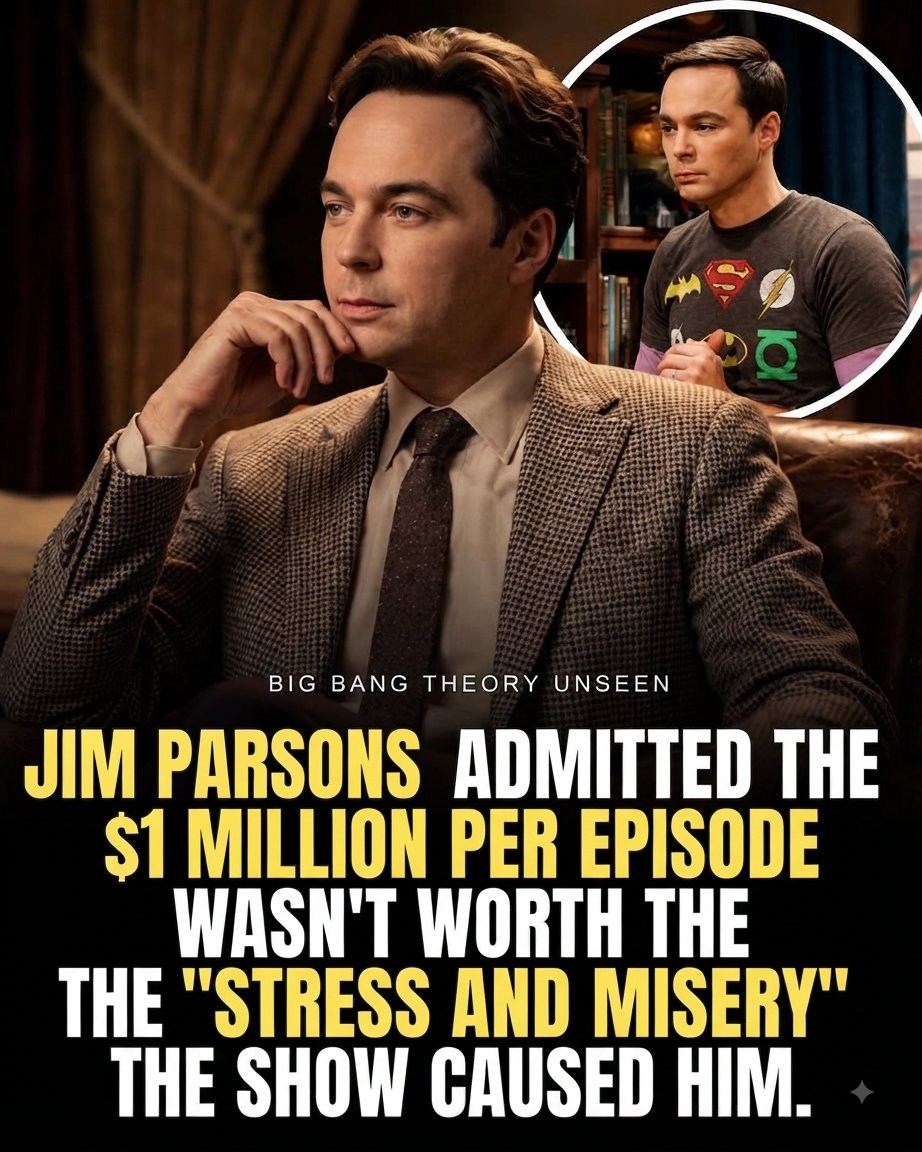
For twelve seasons, Jim Parsons appeared to have one of the most enviable careers in television.
As Sheldon Cooper on The Big Bang Theory, he became one of the most recognizable sitcom actors in the world, earned four Primetime Emmy Awards, received enormous financial rewards, and helped lead a series that became one of the biggest television successes of its generation.
From the outside, it looked almost impossible to imagine that anything could be wrong.
But years after the sitcom ended, Parsons offered a remarkably candid explanation of what life was actually like behind the success. During an appearance on the All Out with Jon Dean podcast, the actor reflected on the enormous pressure he placed on himself throughout the show's run — and admitted that some of the happiest-looking years of his life were, internally, much more difficult than they appeared.
“I look back now and realize that there were many ways, at some of the best moments of my life, I was miserable. I was not happy. I was stressed.”
That admission changes the way the story of Jim Parsons and The Big Bang Theory can be viewed.
The show was an extraordinary success.
But success and happiness, Parsons eventually realized, were not necessarily the same thing.
The Success Everyone Could See
When The Big Bang Theory premiered in 2007, nobody could have predicted just how enormous it would become.
Parsons was relatively unknown to mainstream television audiences when he stepped into the role of Sheldon Cooper. The character was unusual, difficult, socially disconnected, brilliant, frustrating, and unlike almost anyone else on television.
Yet Parsons found the exact rhythm the role required.
His performance transformed Sheldon from a potentially one-dimensional eccentric into one of the defining sitcom characters of the 21st century.
As the series grew, so did Parsons' profile.
Awards followed. Recognition followed. His salary increased dramatically. By the final seasons, Parsons was reportedly earning close to $1 million per episode.
On paper, it was the ultimate Hollywood success story.
But Parsons' later reflections revealed that the numbers didn't tell the whole story.
The bigger the show became, the more pressure he felt to maintain the machine that had created that success.
“I Was Not Happy”
The most striking part of Parsons' retrospective wasn't that he disliked the show.
He didn't.
His comments were much more complicated than that.
He was describing what it felt like to be living inside a period of enormous professional achievement while simultaneously becoming overwhelmed by the expectations he had placed upon himself.
Parsons explained that he believed the success surrounding him was connected to how hard he was working and how disciplined he could force himself to be.
“I felt that there was so many plates I was supposed to be keeping in the air,” he explained, describing his belief that the good things happening in his life were somehow dependent on his ability to keep pushing himself.
That mentality can be difficult to recognize while you're inside it.
A successful project creates more opportunities.
More opportunities create more responsibilities.
More responsibilities create pressure.
And eventually, working harder can begin to feel less like ambition and more like something you simply cannot stop doing.
For Parsons, that cycle became increasingly exhausting.
The Pressure Behind Nearly $1 Million an Episode
The financial success of The Big Bang Theory is often remembered as one of the great television salary stories.
Parsons, Johnny Galecki, and Kaley Cuoco eventually reached the extraordinary figure of roughly $1 million per episode.
The number became symbolic of how valuable the actors had become to the series.
But Parsons' later comments provide a different way of looking at that achievement.
Money can measure professional value.
It cannot measure emotional wellbeing.
Earning enormous sums does not automatically make long working days easier. Fame does not eliminate anxiety. Awards do not necessarily remove exhaustion.
And being part of one of television's most successful shows does not mean every moment of the experience feels successful personally.
Parsons' comments are striking precisely because he wasn't speaking from a position of failure.
He was speaking after achieving almost everything an actor could reasonably want.
And yet he still found himself looking backward and thinking about the price he had paid.
The Work Ethic That Became Something More
Parsons also described the way his work habits developed during those years.
He revealed that he was sober for the first nine years he worked on The Big Bang Theory, and explained that his behavior later snowballed into an intense pattern of overworking.
What he initially viewed as discipline eventually became something much harder to control.
He later described it as “obsessive behavior” and said it could be “kind of OCD in nature.”
The distinction matters.
There is a popular romantic idea surrounding successful performers: work harder than everyone else, sacrifice everything, stay disciplined, and eventually the results will justify the effort.
Parsons' experience complicates that idea.
Working hard helped him succeed.
But pushing himself relentlessly also came with consequences.
Eventually, the behavior that contributed to his professional achievements became part of what made the experience emotionally difficult.
“I Wouldn't Do That Again”
Perhaps the clearest part of Parsons' reflection was his answer when considering whether he would repeat the experience.
His conclusion was remarkably direct.
“I wouldn’t do that again and for any amount of money.”
That statement carries considerable weight coming from someone who had been paid extraordinary amounts to do the job.
He wasn't saying the money wasn't valuable.
He wasn't saying the success wasn't meaningful.
He was saying that there were experiences during those years that he would not willingly recreate simply because the financial reward was enormous.
“I made myself miserable,” he admitted.
There is something unusually honest about that sentence.
It removes the glamour from the story.
There is no villain to blame. No network executive forcing him into misery. No dramatic scandal.
Instead, Parsons recognized his own role in creating the pressure.
He had demanded so much from himself that success itself became part of the burden.
The Decision to Leave in 2018 Looks Different Now
Parsons' comments also cast new light on the decision that shocked The Big Bang Theory fans in 2018.
At the time, Parsons chose not to continue the series beyond its twelfth season despite a reported deal worth around $50 million for two additional seasons.
The decision eventually brought the entire show to an end.
It was one of the most consequential choices in the history of the series.
For viewers, it was difficult to understand.
Why would an actor walk away from one of television's biggest shows while being offered tens of millions of dollars?
Parsons' later explanation makes the decision easier to understand.
He had reached a point where continuing simply because the financial opportunity was extraordinary was no longer enough.
There was something more important he needed to consider: himself.
The decision was not necessarily about rejecting Sheldon Cooper or rejecting the people he had worked with.
It was about recognizing that continuing indefinitely was not necessarily the healthiest choice for him.
The End of Sheldon Cooper
When The Big Bang Theory finally ended in 2019, Sheldon Cooper received the emotional conclusion fans had spent twelve seasons waiting for.
He married Amy.
He shared the Nobel Prize in Physics with her.
He finally stood in front of his friends and acknowledged how important they were to him.
It was a fitting ending for the character.
But behind the scenes, another story was also reaching its conclusion.
Jim Parsons was leaving behind a role that had defined more than a decade of his professional life.
Sheldon had become part of television history.
Parsons had become one of the most famous sitcom performers of his generation.
Yet the actor himself was beginning to understand that his identity could not remain completely tied to the demands of the show.
Ending the series meant giving himself permission to move forward.
The Strange Contradiction of a Dream Career
What makes Parsons' story particularly fascinating is the contradiction at its center.
He achieved what countless actors spend their entire careers trying to achieve.
He found a breakout role.
The show became a global phenomenon.
He won major awards.
He became enormously wealthy.
He worked alongside a beloved ensemble for twelve years.
And yet, when looking backward, he could still say that there were periods when he was miserable.
That contradiction is important because success is often presented as a destination.
As though once you arrive, everything automatically feels good.
Parsons' experience demonstrates something more complicated.
You can love the work and still become overwhelmed by it.
You can appreciate your success and still recognize that you were unhappy.
You can be grateful for an opportunity and still decide you don't want to repeat it.
Those ideas can exist simultaneously.
The Human Being Behind Sheldon Cooper
For twelve years, audiences watched Sheldon obsess over schedules, routines, scientific achievements, professional recognition, and the pursuit of intellectual excellence.
In some ways, the character's obsessive nature makes Parsons' real-life experience especially interesting.
The actor was nothing like Sheldon in personality, but he understood something about the character's relentless pursuit of control.
Sheldon wanted everything to be perfect.
Parsons eventually realized that his own life did not need to be.
He didn't have to keep every plate in the air.
He didn't have to prove that he deserved the success he had already earned.
And he didn't have to sacrifice his wellbeing simply because the rewards were enormous.
That may be one of the most meaningful lessons to emerge from his retrospective comments.
What Fans May Have Missed
For viewers, The Big Bang Theory was primarily a source of entertainment.
Fans watched Sheldon argue with Leonard.
They watched Penny and Leonard's relationship develop.
They watched Howard become a husband and father.
They watched Raj struggle with romance.
They watched Amy and Sheldon transform from an awkward scientific partnership into one of television's most unlikely love stories.
Behind all of that was an exhausting production schedule involving years of rehearsals, filming, publicity, interviews, awards campaigns, travel, and the constant expectation to maintain the standard of a massively successful television series.
Audiences saw the finished product.
Parsons lived the process.
And sometimes the two experiences can be completely different.
Why His Honesty Matters
Parsons' comments are valuable because they challenge the assumption that people who appear successful must automatically be happy.
Celebrity culture often presents achievement as evidence of emotional fulfillment.
A successful actor must be living the dream.
A massive paycheck must mean everything is going well.
A celebrated television show must be an endlessly wonderful experience.
Reality is rarely that simple.
Parsons' willingness to acknowledge the difficult side of his success makes his story considerably more relatable.
Millions of people experience their own versions of the same contradiction.
They can be grateful for their jobs while being exhausted by them.
They can be proud of their achievements while recognizing that they pushed themselves too hard.
They can love something and still know when it is time to walk away.
Parsons simply experienced that contradiction on a much larger public stage.
Final Thoughts
Jim Parsons' story is not really a story about rejecting success.
It is a story about learning that success has limits.
For twelve seasons, he helped create one of television's most successful sitcoms. He earned extraordinary amounts of money, won four Emmys, became internationally famous, and gave audiences a character they will probably remember for generations.
But years later, he was able to look back honestly and admit that some of those supposedly perfect years were also among the most stressful periods of his life.
“I was not happy. I was stressed.”
That may be uncomfortable for fans to hear, but it is also profoundly human.
The decision to leave The Big Bang Theory suddenly makes more sense when viewed through that perspective. Walking away from a reported $50 million


No comments yet